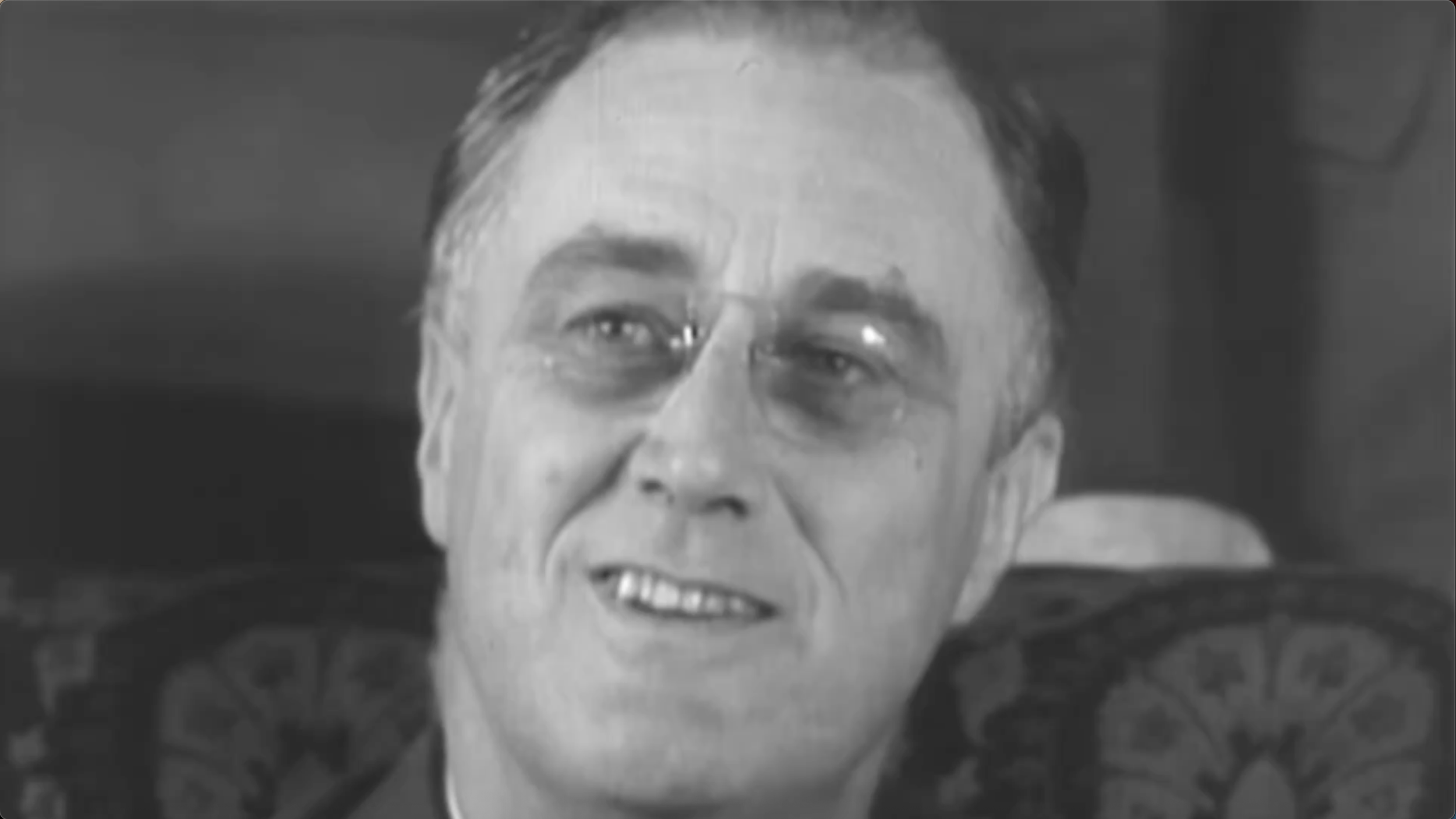
White House-Work: The Unwaged Labor of America’s Wife
Curated by Talia H. Rehill
“Being first lady requires a woman to act…as a mixture of queen, club woman, and starlet.”
-Lewis L. Gould, presidential scholar (Watson, 1997, p. 805)
Introduction
The first lady does not untether from the kitchen table. She carries it with her through every public arena—onto the campaign trail and eventually into the East Room. Carrie Mae Weems knew this. In her 1990 Kitchen Table Series, Weems staged the kitchen table as the site where women's lives are simultaneously most intimate and most surveilled, for a woman can sit at the center of her own life and still somehow disappear into it. The first lady is Weems' woman writ national. While today her husband is paid $400,000 a year (U.S. Code, Title 3, § 102), the first lady functions as an unwaged laborer of the American state, performing essential emotional and affective labor that compliments the president. Through figures like Eleanor Roosevelt and Jacqueline Kennedy, this project argues that while the role appears symbolic, it constitutes a form of gendered political labor that is simultaneously indispensable and structurally unrecognized. After all, the kitchen table is just in a bigger and whiter house.
Introducing
the Characters
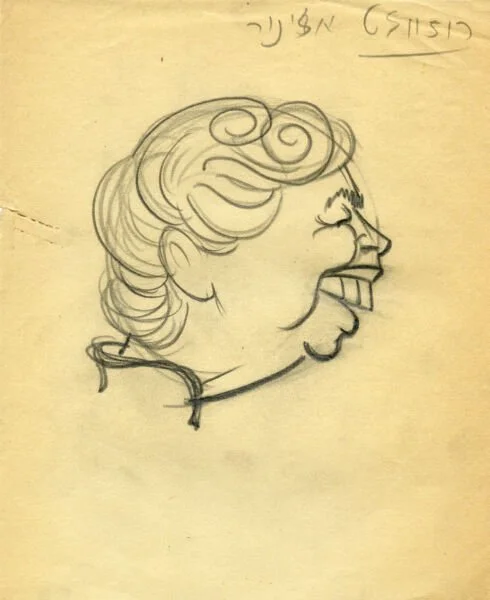
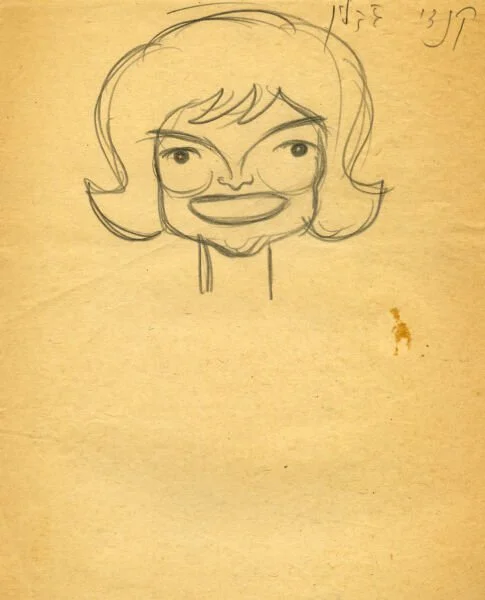
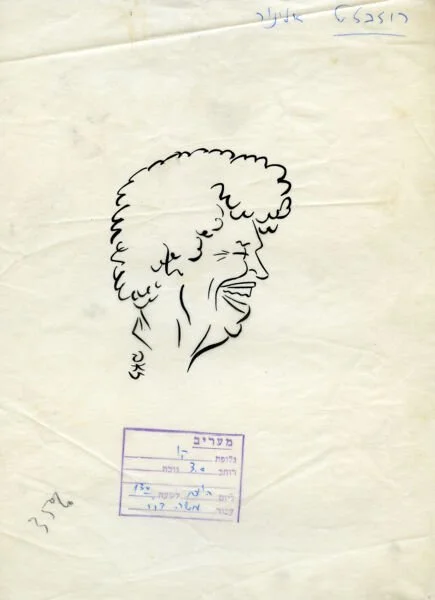
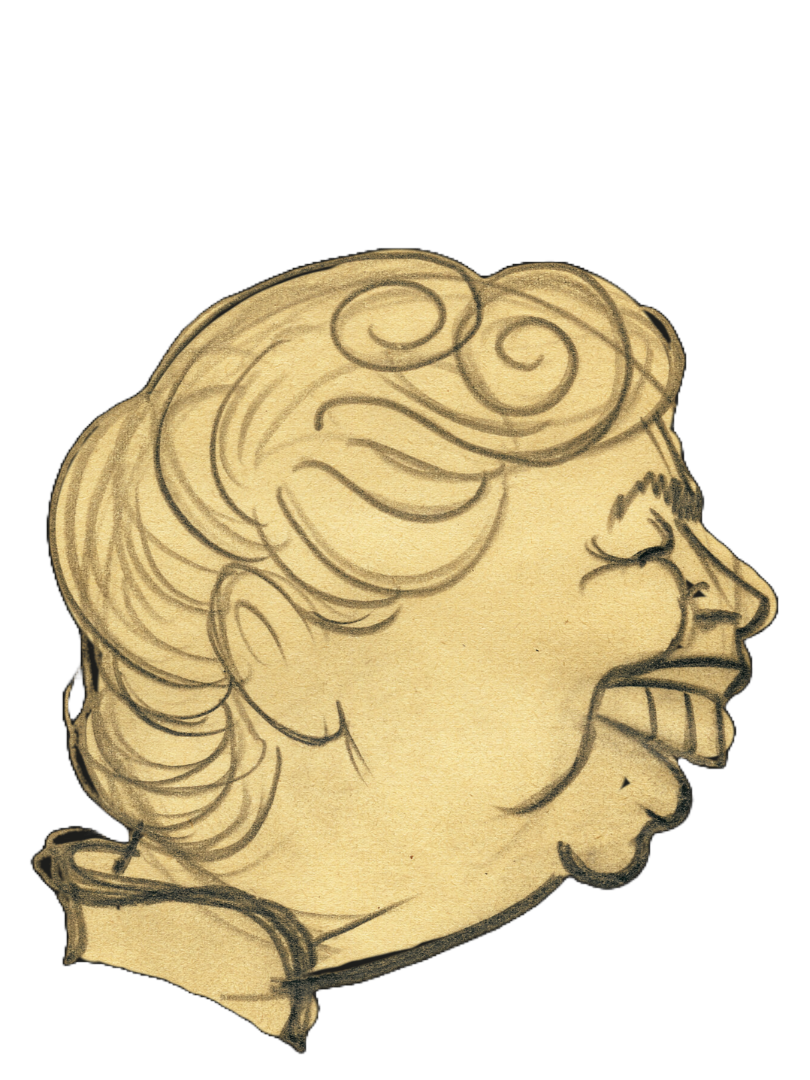
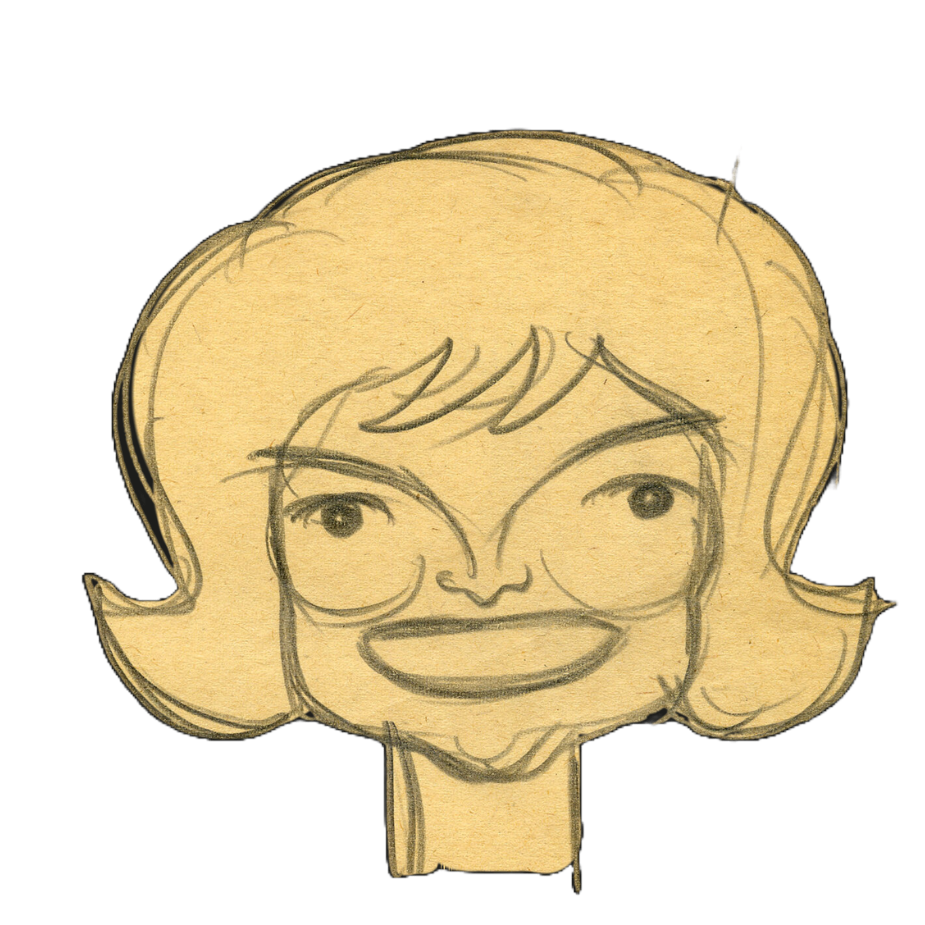
Andy Warhol famously compiled a quadrant of Jackies, each of their own vibrant Camelot color. Never making it onto the canvas, though, was an artist following suit in his “Cartoons of the First Lady.” Ze’ev (Ya’akov Farkash) was an Israeli colorblind cartoonist who coped with his occupation in various World War II concentration camps through art, surviving to create portraits of America’s wives. Uniquely, of all of the prominent women that paint the face of the nation, only two cartoons exist in Harvard’s comprehensive collection: Eleanor Roosevelt and Jackie Kennedy. Whether this be by Ze’ev’s design or a matter of what the institution could grab hold of, there is reason to believe that these women are conjoined as to foil one another.
Eleanor Roosevelt’s drafts to final version between 1952 and 1962 are titled “Cartoons of the First Lady of America.” They orbit the ugliness of her side profile, with her teeth protruding and her chin recessing. Hebrew creeps into the crevices of the page, only quibbling with the trivials of the artist’s information and some archival cataloguing information.
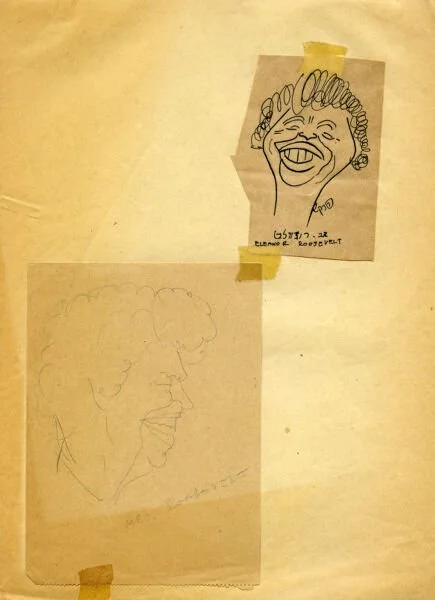
Cartoons of the First Lady of America, Eleanor Roosevelt, by illustrator and cartoonist Ze’ev (Ya’akov Farkash). (1952).
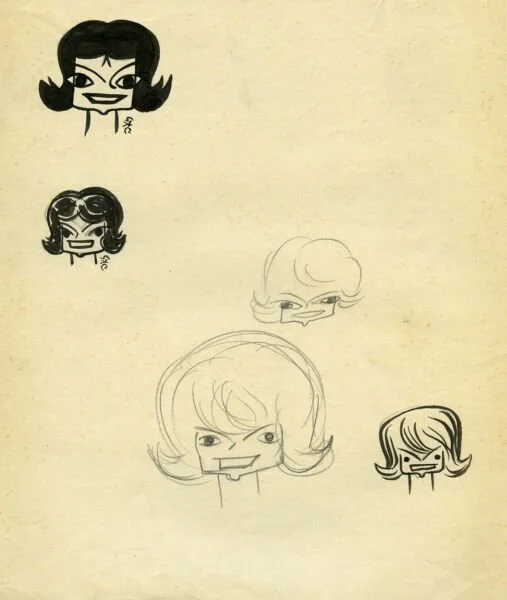
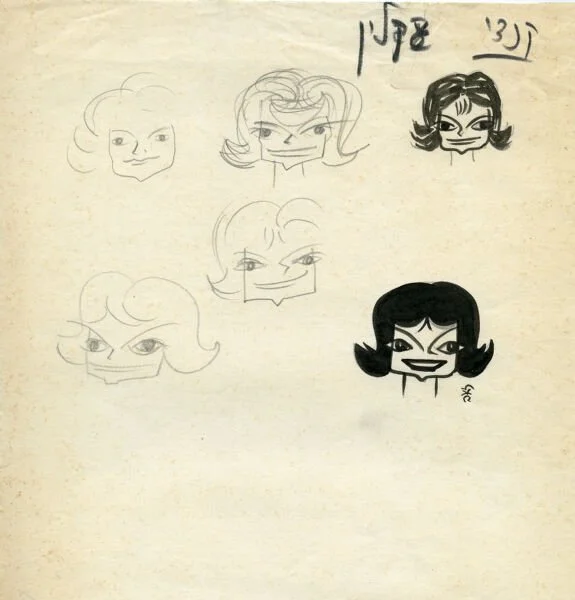
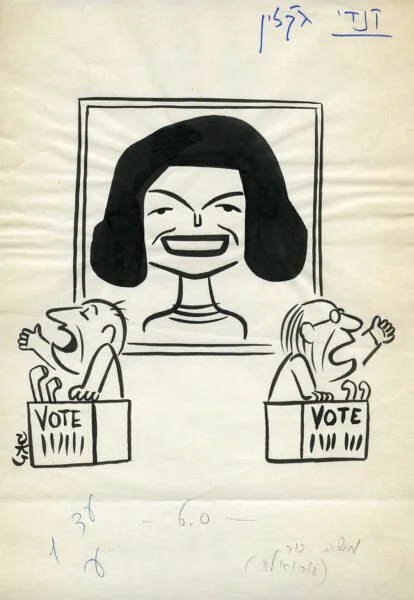
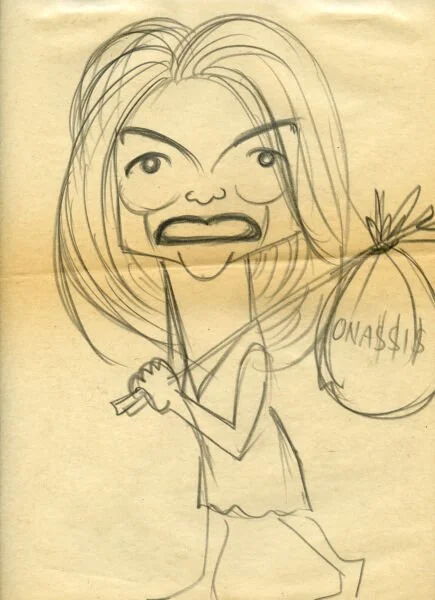
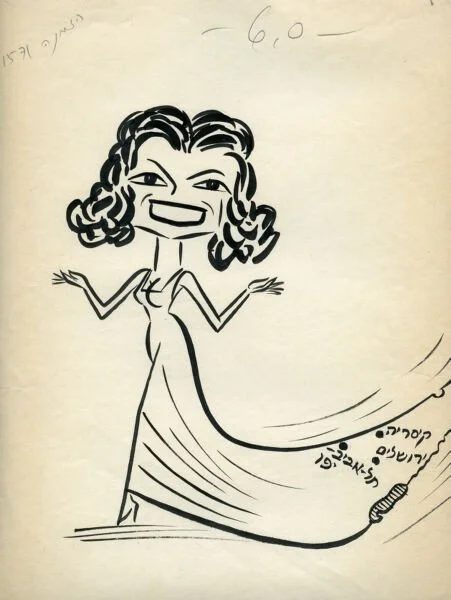
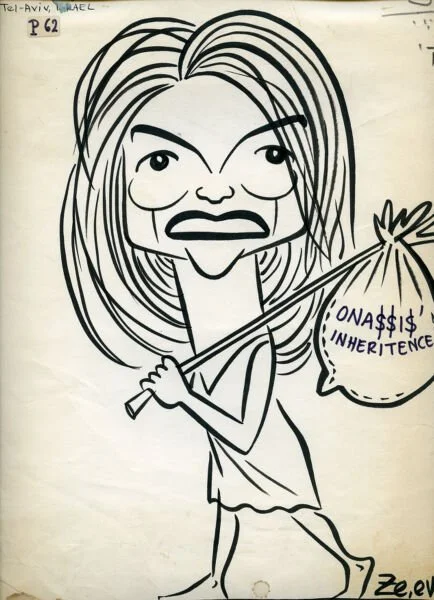
Cartoons of the First Lady, Jacqueline Lee “Jackie” Kennedy Onassis, by illustrator and cartoonist Ze’ev (Ya’akov Farkash). (1952).
On the flip side, Jackie belongs to the collection “Cartoons of the First Lady.” She loses the “of America” for reasons readable in the progression of the cartoons, for she remarries Greek magnate Aristotle Onassis after the assassination of President Kennedy. The Hebrew-speaker even branches into English to depict Jackie’s “ONASSIS” and later “ONASSIS INHERITANCE” money bags, but reverts to Hebrew to hide on her wedding dress “Katharine Hepburn.” After all, “Being first lady requires a woman to act…a mixture of queen, club woman, and starlet” (Watson, 1997, p. 805).
Andy Warhol and Ze’ev are just two artists who share a spot in the Harvard Library, showcasing the first ladies. And while “Eleanor Roosevelt” and “Jackie Kennedy” pinged the keywords of various results under Harvard’s ownership, most of these archives were mere portraits, institutional photographs, or correspondence with other hot-spot people in Harvard’s Houghton and Schlesinger libraries. Their names, like their acclaimed autographs, surface on every search but the content beneath is empty. Therefore, this research project does more than just exhibit the archive and analyze it, it demonstrates a robust learning curve that actually created a ridge in the brain that can only come from both fondling and failing at the archives.
Terms of Service
If a first lady does not want to serve in the role, does she have to? The answer is neither a simple yes nor a no. There is no formal rulebook that defines the position of First Lady of the United States. Instead, the role is shaped by centuries of precedent that precede her. To say no to a first lady tradition places her against the scrutiny of both the nation and the domestic sphere she is publicly tied to through marriage. Beyond the visible moments few and far between, much of her work remains diffuse. Taken together, the following terms offer a layered theoretical vocabulary for understanding the pressures that shape and sustain the first lady’s role.
Defining consent. To define consent through Emily Owens is to immediately destabilize its apparent simplicity. Rather than treating consent as a clear expression of individual will, Owens (2021) situates it within a longer political history in which “consent—traditionally understood as the expression of free will, or choice, of an autonomous subject—emerged in western political thought” alongside liberal democracy and its exclusions (p. 56). In this formulation, consent is not merely a personal agreement but a foundational political fiction that both produces and limits who counts as a subject capable of choice. Crucially, Owens shows that consent has always legitimated freedom for some, only while simultaneously authorizing domination over others. As she writes, “consent…functioned as a tool to justify and maintain the unfreedom of everyone else” (p. 57). And while a woman’s consent may be epitomized by the verbal pronunciation of “I do,” Owens rings true in revealing that marriage stages an unequal exchange of freedom between who wears black versus who wears white on the day of dominion.
More often than not, a first lady does not consent to the conventions of her role when she joins her husband’s hand in holy matrimony. The private utterance “I do” mirrors the public “I will” of men’s political consent. For women, however, this moment of consent paradoxically dissolves autonomy: “the expression of self-sovereignty gave way to someone else’s rule, and in the case of white women, this process made their submission to the will of their husband the defining quality of their freedom” (p. 56). Consent, then, is not the preservation of agency but its transformation into a socially legible form of subordination.
If marriage historically converts a woman’s private consent into a structure of gendered obligation, the presidency amplifies this process onto a national stage. The first lady’s initial consent, to merely marry one man, becomes retroactively reinterpreted as consent to serve as a public representative of the nation itself. In this sense, she is transformed from a wife of one man into a wife of the nation through the expansion of expectations attached to her marital status. While there is no explicit contract binding her to public service, the gendered expectations surrounding the role operate as a powerful form of compulsion. Her “consent” is therefore less a core wedding memory than an ongoing, ever-expanding condition contingent on the liberal notions of choice.
Defining emotional labor. Emotional labor offers a critical framework for understanding the first lady not simply through the trivial conference or Christmas décor, but as a role structured through the management of feeling. Originally defined by Arlie Hochschild (1983, as cited in Hochschild, 2018) as “the work…which centrally involves trying to feel the right feeling for the job,” emotional labor requires the active “evoking and suppressing” of emotion in accordance with external expectations (p. 3). Though unelected and unpaid, she is nevertheless expected to produce a continuous emotional atmosphere for the nation that is somehow both amatorial and maternal. These expectations align closely with what Hochschild has described as “unpaid, invisible work…to keep those around us comfortable and happy” (p. 2), yet in this context they are scaled to the level of national representation. The first lady becomes responsible not only for managing her own emotions, but for mediating the emotional relationship between the presidency and the public. Her presence at moments of climax, whether celebration or crisis, is constitutive of how those moments are absorbed.
Understanding its outsourcing. An extension of emotional labor in this context requires attention to how it is not only performed but also redistributed and concealed through systems of labor beneath it. Hochschild’s (2005) work on the commercialization of intimate life makes clear that modern subjects increasingly “‘farm out certain tasks and obligations to focus more attention on the activities, relationships and causes they care most about’” (Sandholtz et al., 2004, as cited in p. 3). This logic of outsourcing, borrowed from corporate models of specialization, restructures the conditions under which emotional labor can be performed by the first lady. Her ability to sustain a public-facing role depends on the displacement of its logistical and intellectual infrastructure onto the committees she names, the historians she consults, the curators she commissions, and the domestic staff she recruits while rendering invisible. As Hochschild notes, “responsibility for the task goes out,” while others enter the space “with their own notions…of a ‘good home’” (p. 3). In this sense, emotional labor at the highest level is contingent upon the displacement of other forms of labor downward, often along intersections of race and gender.
Defining affective labor. Affect, as theorized in cultural studies, is not reducible to individual feeling or even socially legible emotion. Rather, it is a “prepersonal intensity…implying an augmentation or diminution in the body’s capacity to act” (Shouse, 2005, p. 1). As Ann Cvetkovich (2020) further suggests, affect functions as an “umbrella term” that traverses the boundaries between mind and body, private and public, linking intimate sensation to broader social and political formations (p. 5). Positioned alongside emotional labor, affective labor becomes legible as the work of producing and sustaining these ambient intensities—the cultivation of symbolic unity that exceeds any single emotional display. Where emotional labor requires the first lady to “try to feel the right feeling for the job” (Hochschild 2018, 3), affective labor requires her to generate a field of feeling in which others can feel.
Eleanor in the Archives

Wed to Franklin Delano Roosevelt (FDR), Eleanor Roosevelt was active in the Women’s Trade Union League, teaching at the Todhunter School, and supporting women’s political participation via the Democratic Party organizing networks (Franklin D. Roosevelt Presidential Library and Museum, n.d., para. 2). Eleanor’s pre–First Lady work was semi-invisible, as it was constrained within these reform circles and coded as feminized labor. But when her husband hit the campaign trail running, she outpaced him with her activity engaging with key stakeholders that she traveled to and from. From her presence in the archives alone, she was involved with some VIP activists across the United States—including Miriam Van Waters, Edith Sampson, Dorothy West, and Pauli Murray. But like Ze’ev’s depiction, the diving jaw of Eleanor that never seemed to shut was a reflection of her unusual public criticism for being too involved. An overdoer like Eleanor had no time to journal nor keep an appointment book up-to-date (The George Washington University, n.d., para. 1).
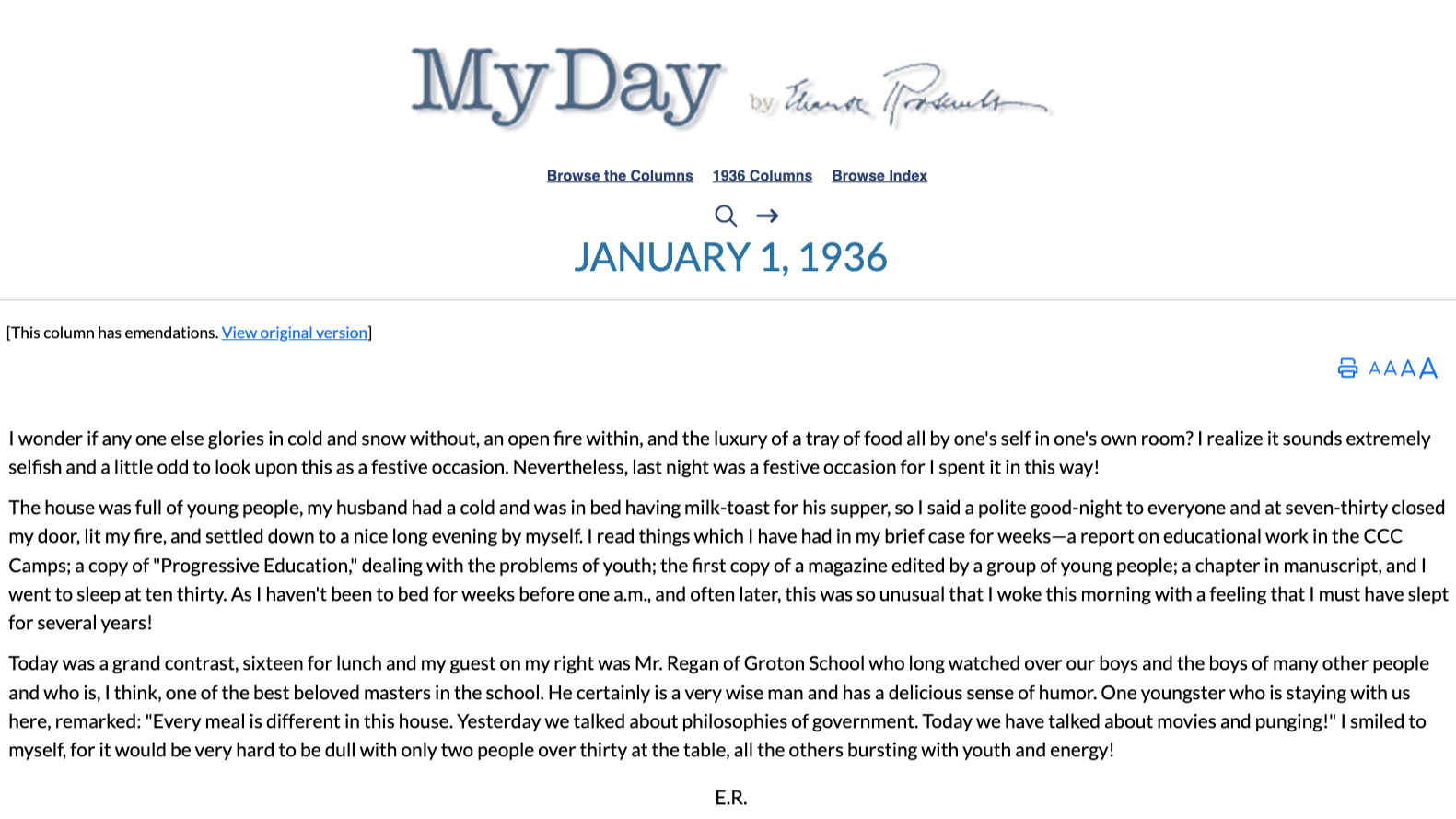
Queue the United Feature Syndicate and their idea of a column for the First Lady. This daily diary-esque entry would be Eleanor’s opportunity to shape her own voice to the media. First published on December 31, 1935, “My Day” required Eleanor to produce a continuous, accessible narrative of her activities, effectively transforming her daily routine into public text. While Eleanor was already an active political participant prior to entering the White House, the demand that she narrate her life six days a week imposed a new form of visibility because she was actively engineering womanly words that softened the masculinity of her actions. Although she received financial compensation for “My Day” through its syndication, this payment left the broader emotional and affective labor that made such writing possible structurally unwaged. In this light, “My Day” represents a partial translation of feminized political labor into market value.
Roosevelt, E. (1936, January 1). My day (column). https://www2.gwu.edu/~erpapers/myday/displaydoc.cfm?_y=1936&_f=md054221a
Roosevelt, E. (1945, April 17). My day (column). https://www2.gwu.edu/~erpapers/myday/displaydoc.cfm?_y=1945&_f=md000001
The death of her husband was the shift toward political individualization, in which Eleanor Roosevelt’s emotional and affective labor did not disappear but was transformed into a form of autonomous political authorship. Her December 10, 1948 “My Day” entry, written from Paris during the adoption of the Universal Declaration of Human Rights, reveals the full transformation of her role to political actor. In recounting debates within the United Nations, Roosevelt positions herself not as an observer but as an active negotiator, navigating ideological conflict between the Soviet delegation, Latin American representatives, and religious factions. Her admission that she “would have been delighted” to include a reference to God, yet chose not to force a vote, exemplifies emotional labor at a diplomatic scale: the deliberate suppression of personal conviction in order to sustain collective agreement. At the same time, her insistence that the declaration will generate a “silent pressure of the masses…in the Kremlin…or any other government abode” reflects a shift toward affective labor, as she imagines the production of a global moral consciousness capable of shaping political behavior. Unlike her earlier columns, which embed political concerns within domestic narrative and humor, this entry abandons the language of intimacy in favor of institutional authority. Writing in the collective voice—“we met,” “no one was deceived”—Roosevelt articulates not only the mechanics of governance but its ethical stakes. In doing so, she moves beyond the consent-based framework that once tethered her public role to her marriage, emerging instead as an autonomous political subject. What remains constant, however, is the labor itself: still oriented toward managing feeling and sustaining cohesion, but now rendered indistinguishable from political power.
Everything changed, though, on April 12, 1945, when FDR died of a stroke just months into his unprecedented fourth term in office. Eleanor, who never missed a beat, had her hand in hiatus for five days until returning to write. While framed as an expression of mourning, the column quickly displaces personal grief into a broader register of collective loss: “any personal sorrow seems to be lost in the general sadness of humanity.” In doing so, Roosevelt performs emotional labor at a national scale, absorbing and redirecting grief away from herself as widow and toward a shared political consciousness. Yet this act of mediation simultaneously enables a shift in authority. Rather than dwelling on her husband as an individual, she reconstructs him as a set of enduring “objectives,” emphasizing his commitment to “a fairer chance for ‘life, liberty and the pursuit of happiness.’” This reframing transforms Roosevelt from a figure who once supported presidential power into one who now interprets and extends it. Her assertion that “it cannot be the work of one man” further redistributes political responsibility, calling upon “many leaders and many peoples” to carry forward the work of building peace. In this moment of rupture, the First Lady’s unwaged emotional labor begins to emerge as autonomous political authorship.
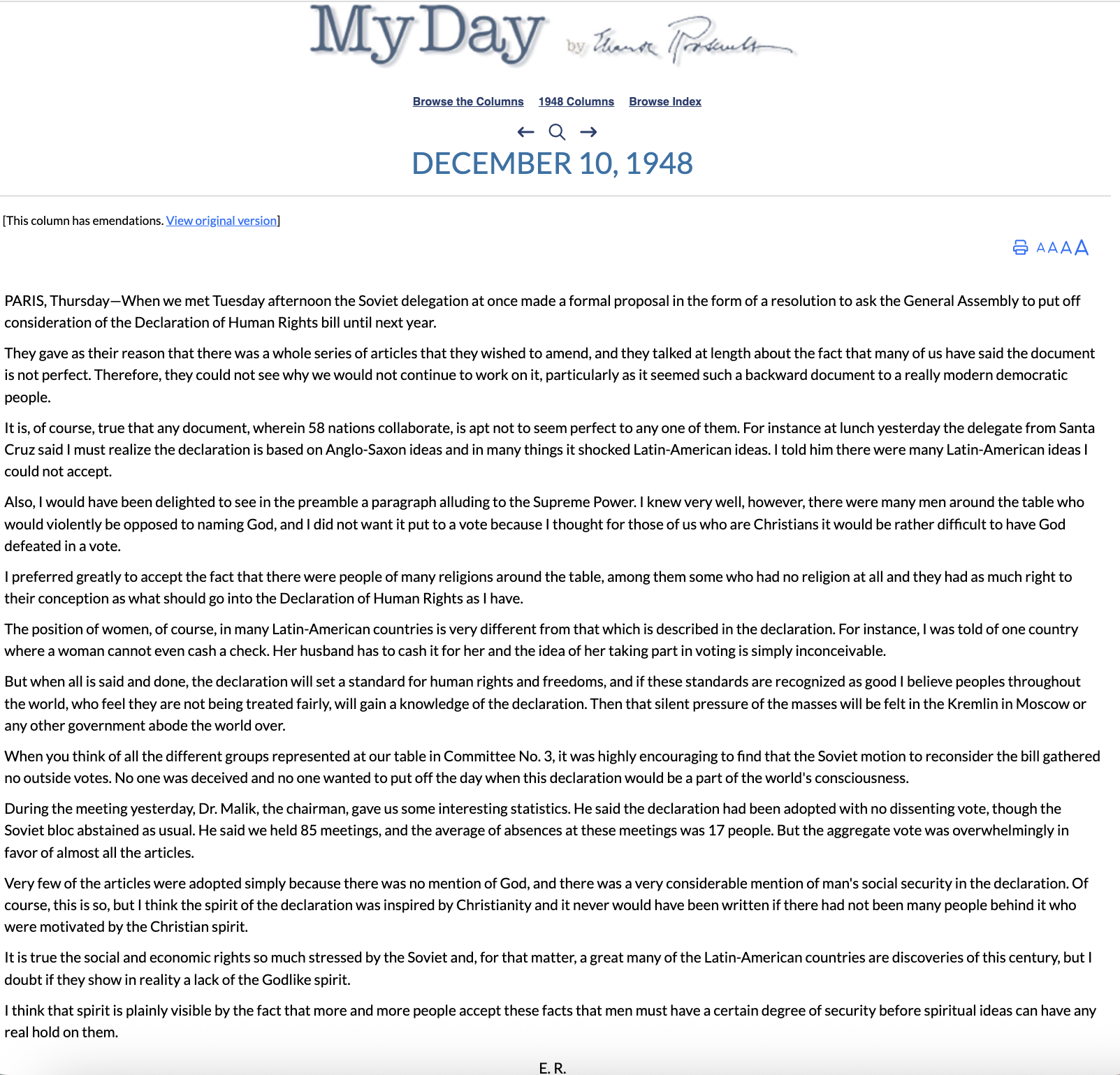
Roosevelt, E. (1948, December 10). My day (column). https://www2.gwu.edu/~erpapers/myday/displaydoc.cfm?_y=1948&_f=md001146
By the early 1960s, Eleanor Roosevelt’s transformation from unwaged political spouse to autonomous political actor had fully crystallized. No longer tethered to the diffuse emotional labor of the First Lady role, she appears in correspondence such as this June 15, 1962 letter not as a political interlocutor—one whose authority JFK not only recognizes but actively engages. Addressed with deference and substantive policy detail, the letter positions Eleanor as a figure to be informed, consulted, and, implicitly, persuaded. In this exchange, the direction of influence subtly inverts: rather than absorbing and mediating presidential power, Roosevelt shapes the contours of it, guiding conversations around women’s employment and federal policy. Her labor, once embedded in the intimate and affective spaces of domestic and national care, now operates openly within formal political structures. Yet this moment of chronological convergence—between former First Lady Roosevelt and sitting President tKennedy—also marks a historical hinge. For as Eleanor’s political authorship reaches its fullest expression, Jackie Kennedy enters the White House under a different set of expectations, one that will reconfigure the visibility and ultimate limits of First Lady labor in the decades to come.
From 1935 until 1962, Eleanor produced her column six days a week until January 1961 when she changed to three days a week. In this vast collection of columns, made accessible and archived as a Eleanor-specific project at the George Washington University, you can see her emotional labor wax and wane. Her first accessible entry from January 1, 1936 offers an ostensibly intimate glimpse into her private life, yet it simultaneously reveals the diffuse and unbounded nature of her labor. Framing a rare evening alone as a “festive occasion,” Roosevelt characterizes solitude as indulgence, implicitly acknowledging the constant demands placed upon her time. However, this moment of “rest” is anything but idle: she describes reading reports on educational work in Civilian Conservation Corps camps, youth-focused publications, and manuscript drafts. Even within a domestic register, Roosevelt embeds political discourse, moving seamlessly from personal anecdote to discussions of education and governance. Her aside that she “hasn't been to bed for weeks before one a.m.” signals sustained exhaustion, yet it is presented casually, almost humorously, rather than as evidence of structural overwork. She canonically continued to write with the same feminine fervor, an almost motherly piece of advice to the listening ear of the country, through the twists and turns and Pearl Harbor maritime terrors of the 1940s.
Jackie in the Archives
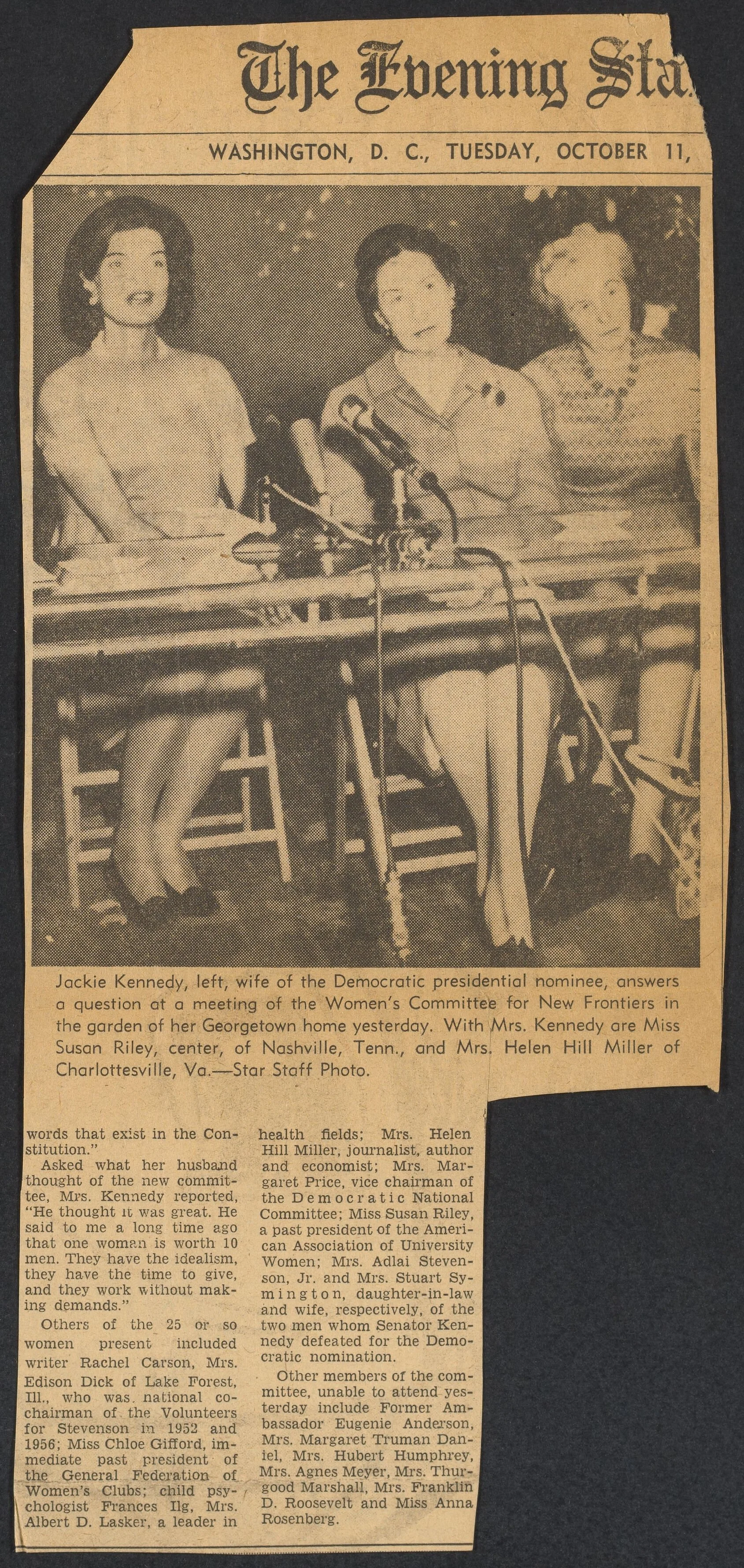
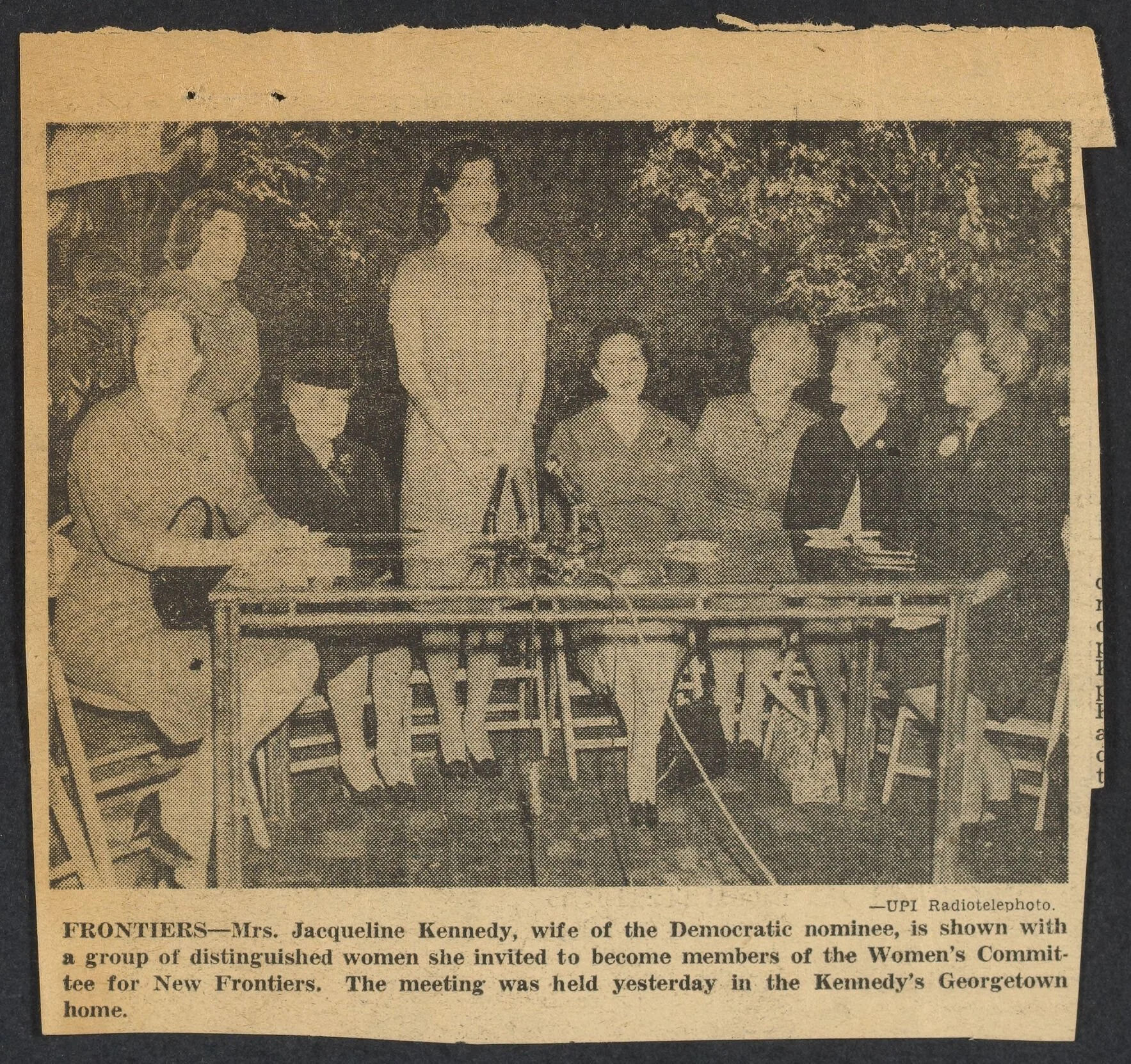
While Jack was pregnant with a presidency, Jackie was pregnant with her second child on the campaign trail. From the outset, the youthful glitz of the candidate couple put all eyes on the first lady prospect, and she responded by building the cast and setting her stage for the show. In October 1960, at the height of JFK’s presidential campaign, Jackie ostensibly hosted a luncheon at her Georgetown home for the newly formed Women’s Committee for New Frontiers, a group composed of “27 of the nation’s most distinguished women” (Cheshire, 1960, para. 3)—including figures like former Secretary of Labor Frances Perkins, diplomat Edith Sampson, and representatives from national women’s organizations—tasked with translating the Democratic platform for a broader female electorate and regurgitating their word to her husband. The Hermes of the household, Jackie “served as a moderator and introduced each speaker, but she herself did not speak on any of the subjects on the agenda” (para. 8). Despite the article’s title, “Women Leaders Scan ‘Frontiers,’” the coverage repeatedly collapses the political into the domestic: the meeting is held “at her Georgetown home,” and Jackie is described as “largely confined by the impending birth of her second child,” as if her proximity to policy must be justified through pregnancy. The absurdity peaks when, nestled among discussions of “education, medical care for the aged, civil rights, [and] foreign policy,” appears the headline “JFK—If It’s a Boy,” elevating the naming of her unborn child to the level of political news, and that is, only if it’s a boy. Even praise reinforces the structure: “one woman is worth ten men in politics,” not because she leads, but because she gives “their time and really work[s]” in service of someone else’s vision. Through Hochschild’s lens, this is emotional labor in its most public form, but unlike Eleanor Roosevelt’s early attempts to cloak her political labor in domestic intimacy, Jackie’s labor is made political because it is safe within the marginal language of motherhood, wifehood, the home, and the kitchen table.
-
![]()
White House luncheon hosted by Jacqueline Kennedy for women reporters, April 11, 1961; includes clippings, invitation, correspondence. Papers of Nona Baldwin Brown, 1908–2001 (inclusive), 1935–1979 (bulk), MC 770, Box 3, Folder 10. Schlesinger Library, Radcliffe Institute, Harvard University.
-
![]()
White House luncheon hosted by Jacqueline Kennedy for women reporters, April 11, 1961; includes clippings, invitation, correspondence. Papers of Nona Baldwin Brown, 1908–2001 (inclusive), 1935–1979 (bulk), MC 770, Box 3, Folder 10. Schlesinger Library, Radcliffe Institute, Harvard University.
-
![]()
White House luncheon hosted by Jacqueline Kennedy for women reporters, April 11, 1961; includes clippings, invitation, correspondence. Papers of Nona Baldwin Brown, 1908–2001 (inclusive), 1935–1979 (bulk), MC 770, Box 3, Folder 10. Schlesinger Library, Radcliffe Institute, Harvard University.
-
![]()
White House luncheon hosted by Jacqueline Kennedy for women reporters, April 11, 1961; includes clippings, invitation, correspondence. Papers of Nona Baldwin Brown, 1908–2001 (inclusive), 1935–1979 (bulk), MC 770, Box 3, Folder 10. Schlesinger Library, Radcliffe Institute, Harvard University.
-
![]()
White House luncheon hosted by Jacqueline Kennedy for women reporters, April 11, 1961; includes clippings, invitation, correspondence. Papers of Nona Baldwin Brown, 1908–2001 (inclusive), 1935–1979 (bulk), MC 770, Box 3, Folder 10. Schlesinger Library, Radcliffe Institute, Harvard University.
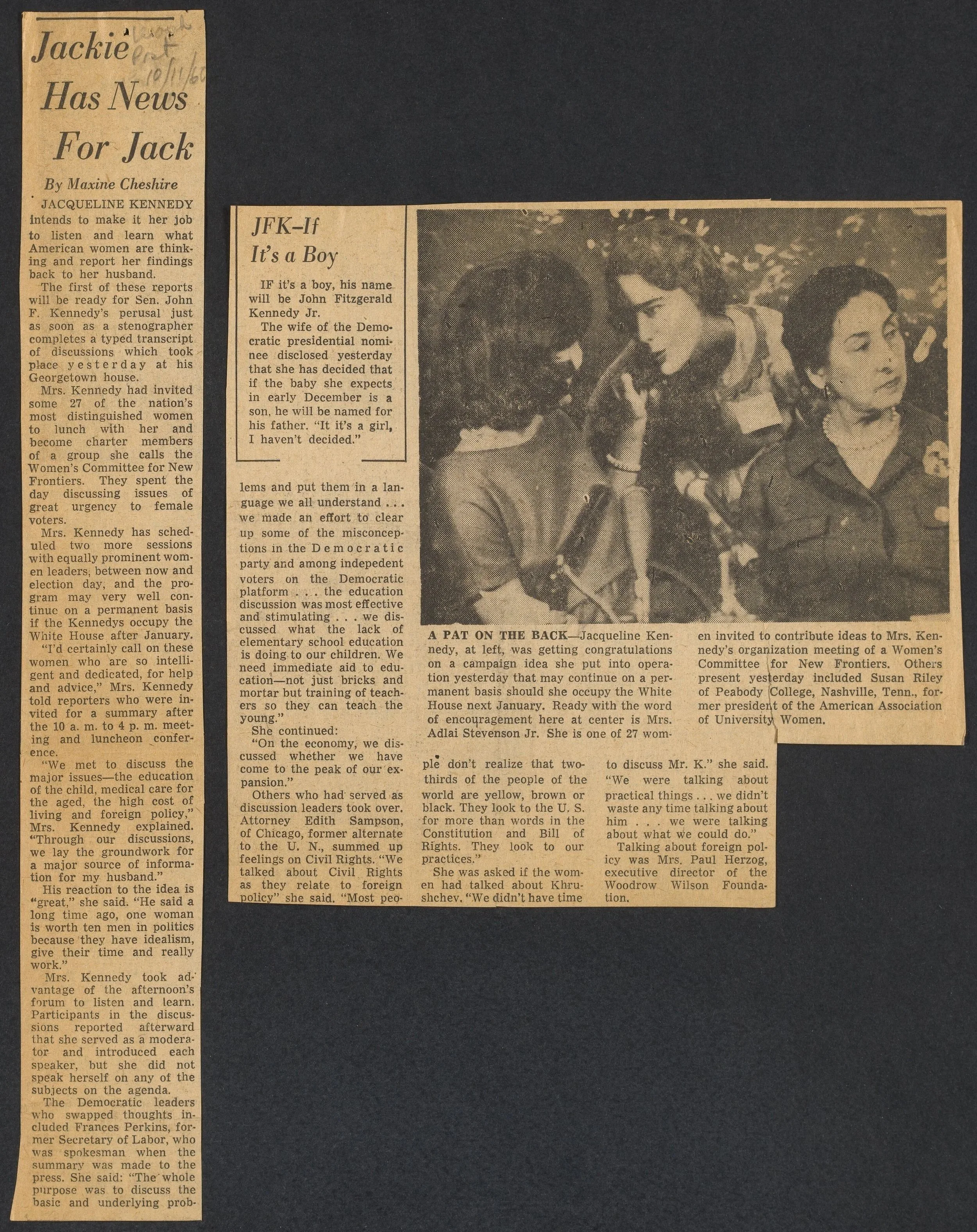
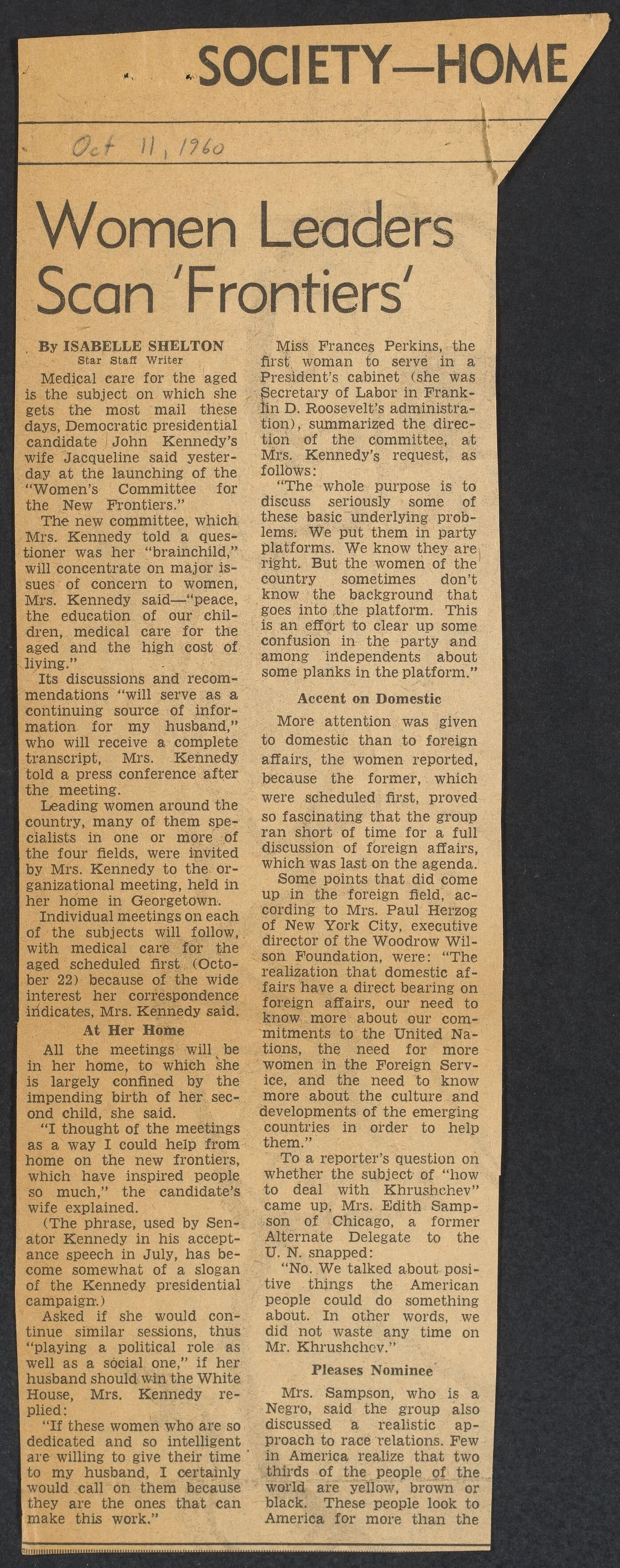
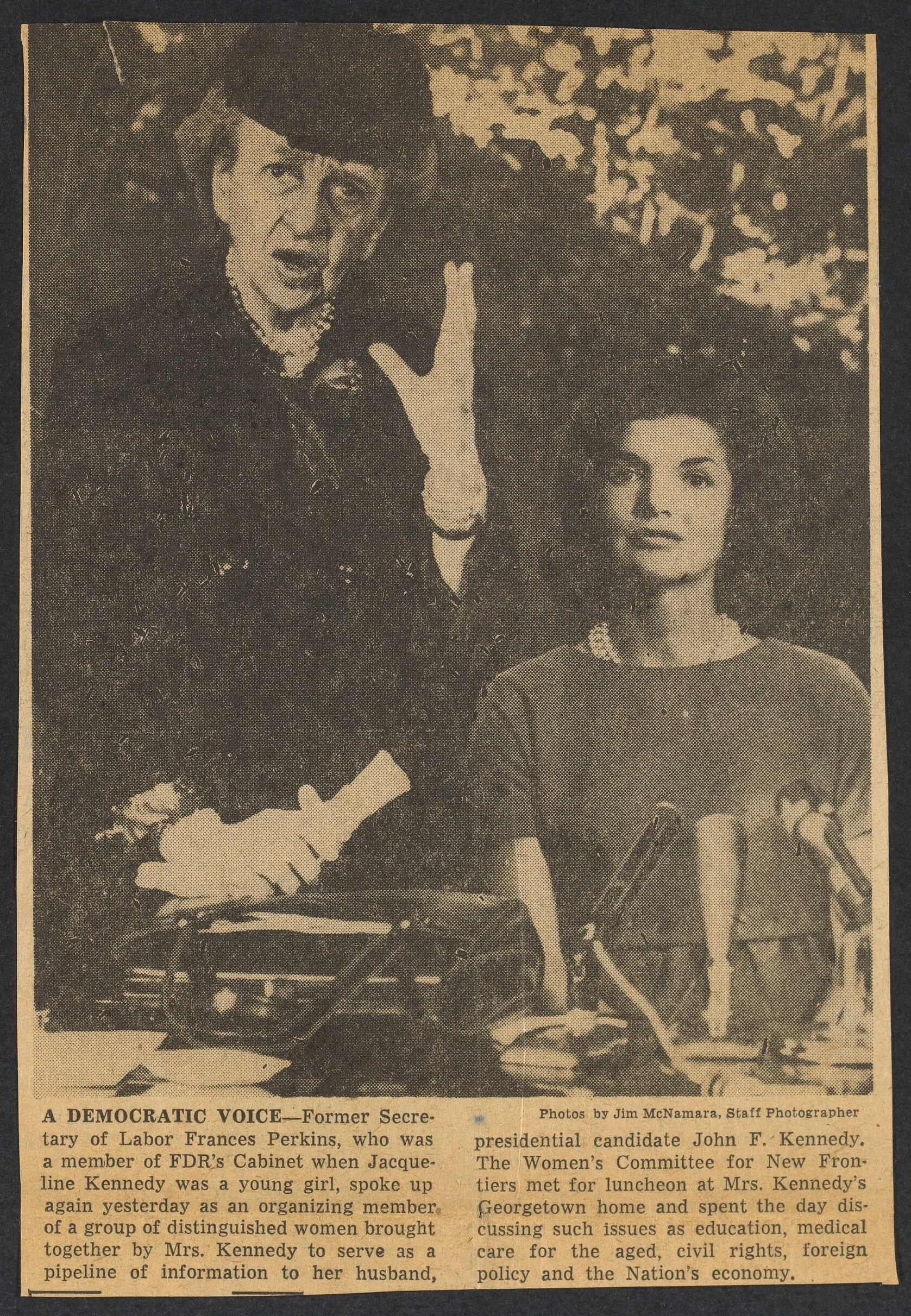
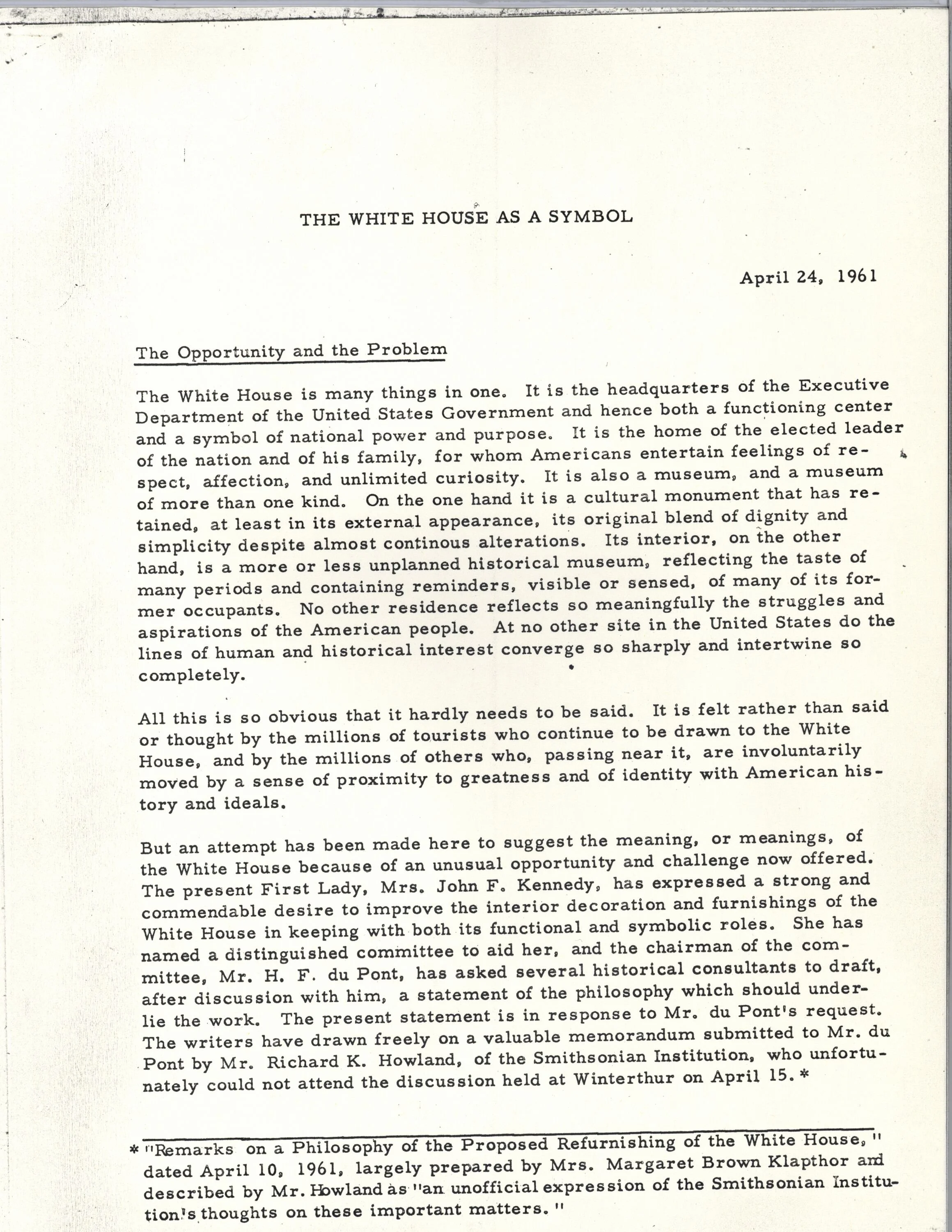
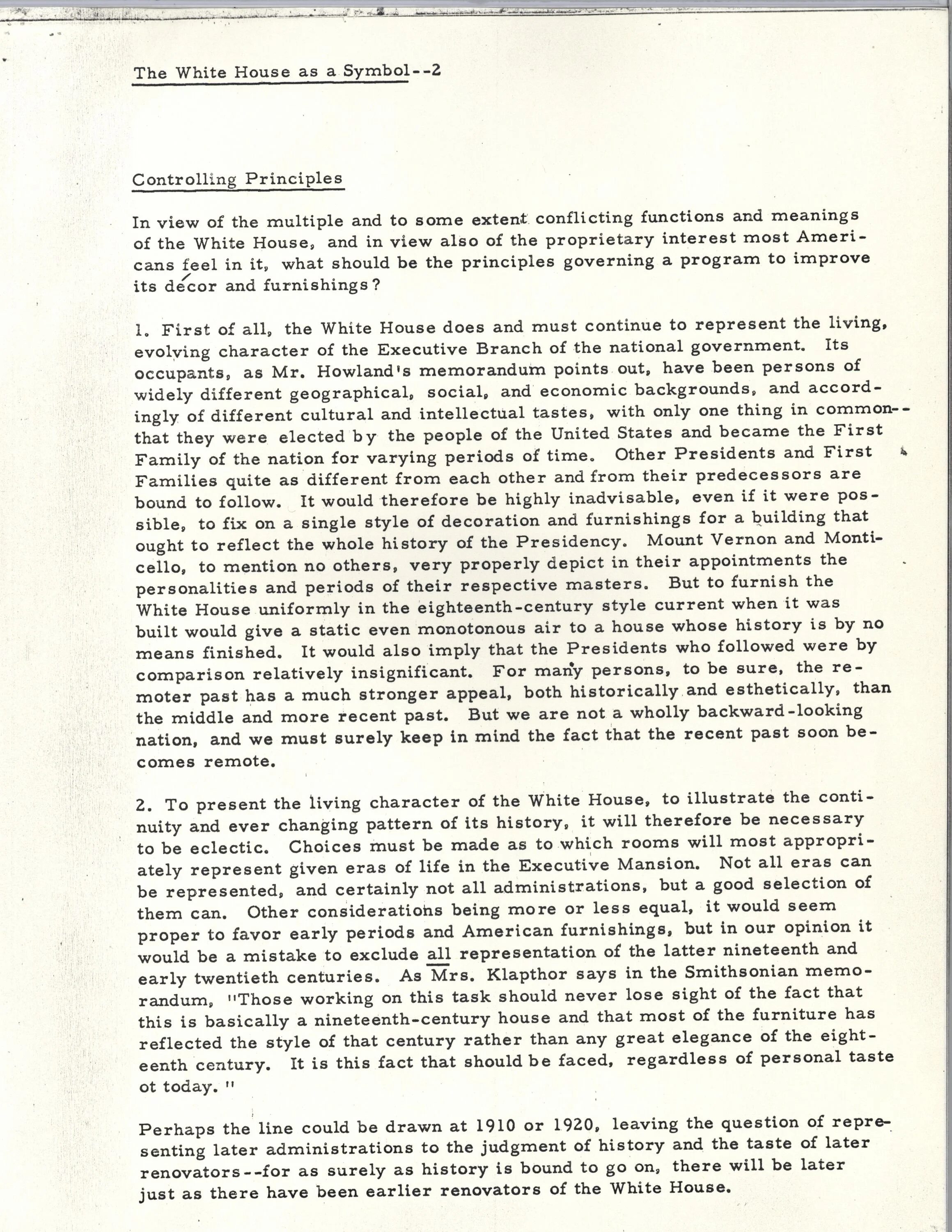
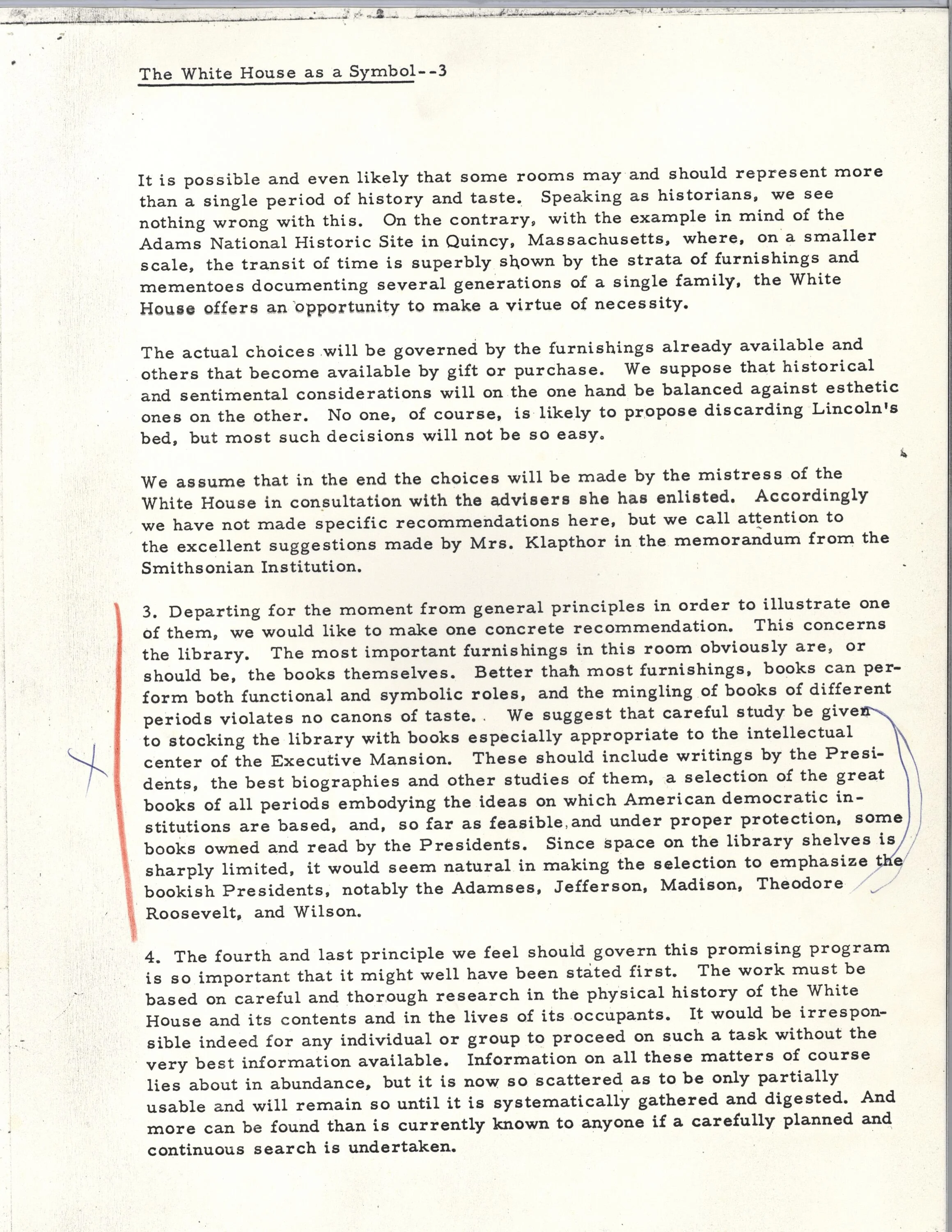
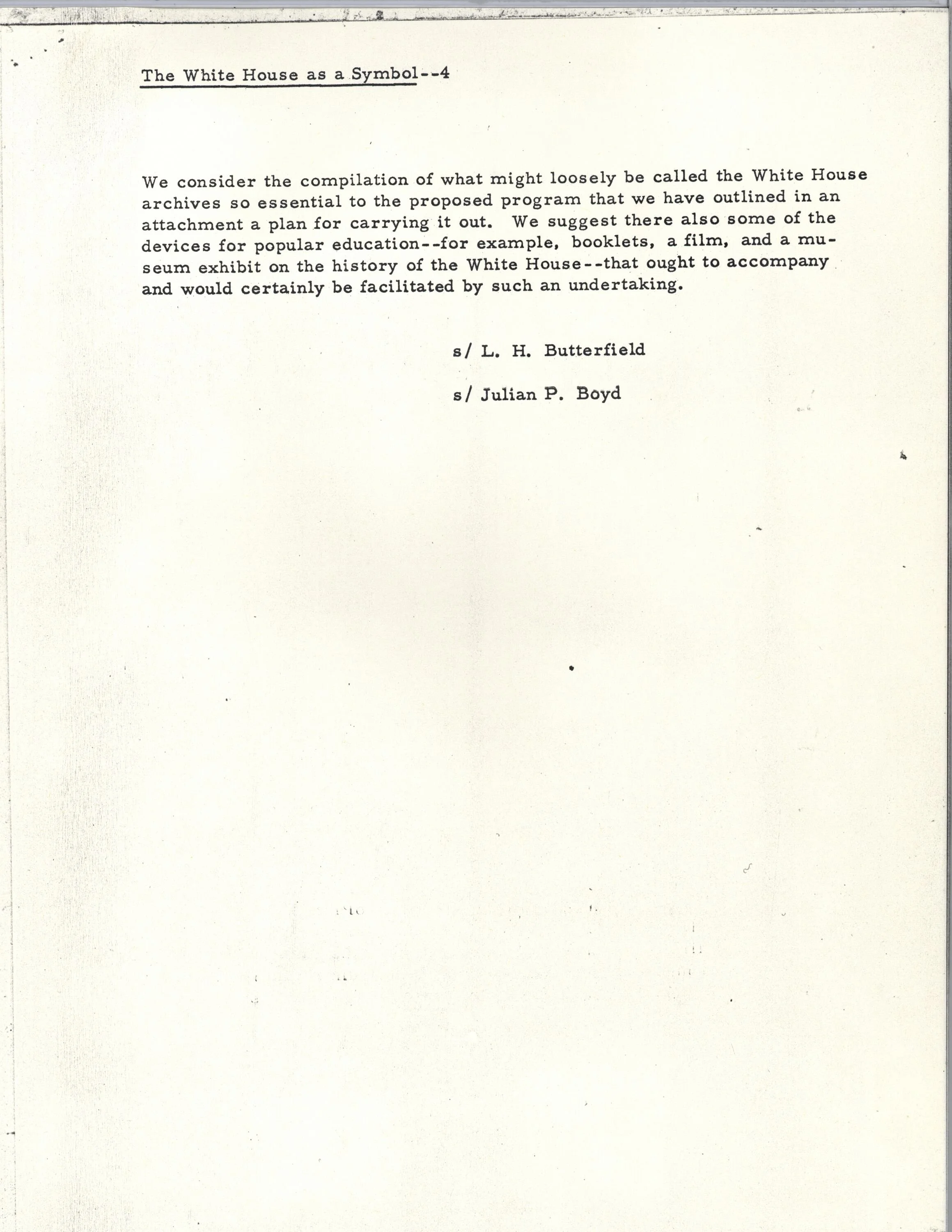
Then came the performance of a lifetime on a stage that had been designed a year in advance. With a razor-thin popular vote victory, Jackie became the First Lady of the United States. Her first task was tidying up the people’s home at the wholescale: a restoration of the White House. In April 1961, historians L.H. Butterfield and Julian P. Boyd drafted "The White House as a Symbol" at Jackie's request, a foundational memorandum articulating the philosophy that should "underlie the work" of the restoration. Their opening argument was affective before it was architectural: the White House, they wrote, is a place where Americans passing near it are "involuntarily moved by a sense of proximity to greatness and of identity with American history and ideals"—a building whose meaning is "felt rather than said or thought" (Butterfield & Boyd, 1961, p. 1). If the White House was a symbol that worked on the body before it worked on the mind, then the first lady who inhabited and restored it was, in Cvetkovich's terms, manufacturing affect at a national scale.
-
![]()
Jacqueline Bouvier Kennedy Onassis Personal Papers. Textual materials. Mary Gallagher files. Arts, 1961. (JBKOPP-SF001-004). John F. Kennedy Presidential Library and Museum.
-
![]()
Jacqueline Bouvier Kennedy Onassis Personal Papers. Textual materials. Mary Gallagher files. Arts, 1961. (JBKOPP-SF001-004). John F. Kennedy Presidential Library and Museum.
-
![]()
Jacqueline Bouvier Kennedy Onassis Personal Papers. Textual materials. Mary Gallagher files. Arts, 1961. (JBKOPP-SF001-004). John F. Kennedy Presidential Library and Museum.
-
![]()
Jacqueline Bouvier Kennedy Onassis Personal Papers. Textual materials. Mary Gallagher files. Arts, 1961. (JBKOPP-SF001-004). John F. Kennedy Presidential Library and Museum.
Jackie was the White House’s most visible furnishing. On February 14, 1962, Jacqueline Kennedy led CBS News correspondent Charles Collingwood through the rooms of the White House in the most-watched televised tour the building had ever seen, broadcast simultaneously on CBS and NBC to an audience estimated to exceed 1,300,000 viewers, with projections far higher. The President himself recorded a closing segment, appearing to "second his wife's efforts to impart a sense of living history to the White House." The labor was hers; the presidential imprimatur was his, affixed after the fact, like a signature on work already done. This is Hochschild's emotional labor scaled to architecture: the "evoking and suppressing" of feeling no longer confined to a single interaction but embedded in the rooms themselves, with Jackie as the conduit through which the nation was invited to feel them. CBS, the network that conceived and produced the special, also made the presentation available to NBC—a lateral transfer of ownership that mirrors, at the institutional level, what the tour performs at the personal one: Jackie generates the affect, others capture the value. She received an honorary Emmy. She was not paid. An honorary award is the institution's way of acknowledging that something extraordinary was produced through labor it has already decided to classify as devotion. The curiosity directed at the building and the curiosity directed at Jackie were, by February 1962, indistinguishable.
CBS News. (2025, October 23). Jacqueline Kennedy’s televised tour of the White House (1962) [Video]. YouTube. https://www.youtube.com/watch?v=pjlu-4VZZkc
The death of her husband was the shift toward political withdrawal, a shift that slowly outsourced emotional and affective labor. Of Jackie’s archive, largely locked away, the greatest presence is of condolence letters. Over 800,000 letters flooded the White House within the first seven weeks, and Jackie was responsible for weighing as worthy of keeping. An act of Hochschield’s outsourcing, she created an outgoing carbon response letter that read as personally from her to nurture the American people, and then she faced the film camera once more. Jackie became the architect of the gravestone and all things funerary atop the reputation of her husband post-death. She was there for the aftermath but not the afterlife, for she remarried and faced the media’s wrath as signaled by Ze’ev.
British Pathé. (2014, April 13). Jackie Kennedy: Thank you for letters of condolence (1964) [Video]. YouTube. https://youtu.be/YvqH23z9_84
Jackie Kennedy died an Onassis on May 19, 1994 of non-Hodgkin’s Lymphoma, but not before burning her personal letters and photos. To be buried next to Camelot, next to her reputation, her archive was the one thing she could control as she knew her death was coming and not dependent on a single assassinating bullet like her first husband.
America’s
Appendages
You must meet what remains of Jackie and Eleanor at the meta-level, as I did. Dozens of archives appear at a singular search for Jackie Kennedy using HOLLIS for Archival Discovery, let alone the hundreds for Eleanor Roosevelt. The first ladies exist in the papers of outsiders, with letters of their own hand holding little relevance to their work as the poster women of the nation. Their absence said it all about how their power was preserved.
Today, the letters of Jackie and Eleanor exist as mere appendages in the archives of their husbands, the former presidents of the United States. Whether it be an in-person branch in their libraries or a digital pop-out, these women exist only as supplements to the presidents’ suppositories—existing far from a women-dominated space like the Arthur and Elizabeth Schlesinger Library on the History of Women in America. In fact, the only colleges/universities that can get a hold of them are the ones Jackie and Eleanor attended. A favicon is the tiny logo in a browser tap, and as I added more and more in fascination of these two females, the two read: JFK and GW, for John F. Kennedy and George Washington. Like the headstone on a grave, the women’s feats are collapsed into the initials of the former presidents wherein their information is housed now.
Conclusion
For this project, the answer was never in the archive. Through history, scholarship has asked whose voices are we taking in and why theirs? Of these voices, whose bodies and brains were being underpinned to promote that legible literacy? The traditional answer points to whose voices were deemed worth preserving, but the first lady scrambles that answer entirely. Eleanor Roosevelt and Jackie Kennedy were among the most photographed and publicly visible women of the twentieth century, and still their archives are nearly empty of them. The problem is that the emotional and affective labor they performed was so thoroughly coded as natural, as wifely that no one thought to file it. After all, you do not archive a feeling or the atmosphere of an entire country. And so the most essential work of the American state's most essential unpaid position left almost no paper trail at all.
Weems’ woman at the kitchen table sits alone by the end of the series. The guests leave, the children sleep, the hair and skin is prepped, and she remains at the table with only the lamp for company—still there, still centered in the frame, but surrounded by absence. That is what it feels like to research a first lady. The archives of Eleanor Roosevelt and Jackie Kennedy are the kitchen table, all set with silverware and full in its seat count. Still, she is nowhere to be found, because the labor of being the feeling that holds everything together leaves almost nothing behind. Eleanor burned letters. Jackie burned more. The archive, unlike the role, was the one thing they could control, and controlling it meant, in the end, disappearing into it.
References
Access the reference list within the text-only document below.